However, there are still English teachers in Semey, and those English teachers still want to improve their English and their teaching skills. So Becky Johnson and I joined with the head of the local English Teachers' Association to organize a two-day training for teachers from the city. We invited two other volunteers, Denise Nyffeler and Roshan Devaraj, to join us. Together we hosted different sessions on the theme “New Methodologies in the English Lesson,” which was purposely vague so we could all teach whatever sessions we wanted to.
Wednesday, May 4, 2011
Teacher Training
The last week of March another volunteer and I organized a teacher training in the city of Semey. Semey, formerly called Semeipalatinsk, is located in the northeastern corner of Kazakhstan. During the Soviet Union, a large area to the west of the city, known as the Polygon, was used as the center for the Soviet nuclear testing program. Some 460 nuclear bombs were exploded there from 1949 to 1989. As a result, the area has a high rate of genetic mutations, mental illness and cancer. Because there's still a lot of radiation in the area, no Peace Corps volunteers are stationed there.
However, there are still English teachers in Semey, and those English teachers still want to improve their English and their teaching skills. So Becky Johnson and I joined with the head of the local English Teachers' Association to organize a two-day training for teachers from the city. We invited two other volunteers, Denise Nyffeler and Roshan Devaraj, to join us. Together we hosted different sessions on the theme “New Methodologies in the English Lesson,” which was purposely vague so we could all teach whatever sessions we wanted to.
Nina Nikolaievna, on the far right, went all out to welcome us to her home and organize every logistical detail of the conference. She found a location to hold it, her school “Zhas Ulan Lyceum,” which is a bordering school for 5th-11th grade boys who are training to be future officers in the army. She got us an apartment to stay in, bought us lunch in a restaurant every day plus food for breakfast and dinner, and even arranged a driver to take us around the city. She also put together two excursions in the afternoons, and finally invited us over to her house for dinner on the last night. Needless to say, we all felt like we got the VIP treatment.
I gave sessions on “Fun and Easy Grammar Activities” and “Working with Ayapova.” Ayapova is our national abysmal textbook that needs all the help it can get. One 45-minute session doesn't even begin to correct all the problems that book has.
Roshan gave presentations on “Lesson Planning” and “Using Visual Aids in the Classroom.”
Denise's presentations were about “Setting High Expectations” and “Critical Thinking.”
Becky talked about “Teaching Vocabulary” and “Teaching Speaking.”
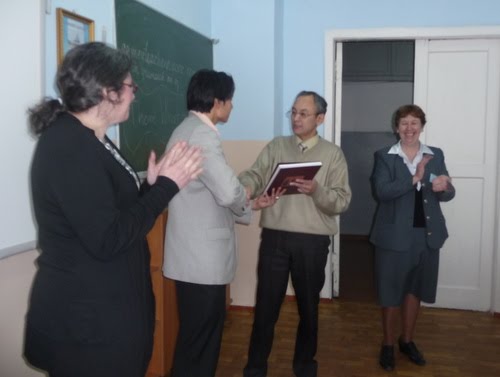
At the end of the training, the English Teachers' Association gave us beautiful books about Kazakh history. Like I said, VIP treatment!
Because of train schedules, we had to be in Semey for three days. Since the training was only two days, we spent the last day holding English clubs with the students from Nina's school. About 40 boys total came to two different sessions of two and a half hours each. Like I mentioned, these boys are training to be future officers. As a result, they have the coolest school uniforms I've ever seen.
Their uniforms for outside.
For the English clubs, we planned to play a lot of games, both to practice their English and their teamwork. As soon as we found out we would be working with teenage boys, we immediately tried to think of ways to tire them out so they couldn't cause as many problems. We did a big team competition, and one of the stations was how fast the team could do 30 pushups each. Standing there with my cellphone/stopwatch, I felt like an army captain, although I didn't yell as much.
Denise and Roshan demonstrate a teamwork game, where two people have to move three pop cans across the table to form a pyramid using only spaghetti and their mouths.
The boys race to complete the task.
For another game, the boys built a tower of cups and index cards. Then they had to pull out the index cards without touching the cups, but in such a way that the cups stacked neatly together.
Another station in the team competition: answering a crossword puzzle using Scrabble pieces.
Our standby game, and a guaranteed crowd pleaser: Uno! I can't begin to count how many times I've played Uno in this country.
Nina organized a couple of excursions around the city, and one of them was to the local art museum. It was a very nice museum, with several pieces from western Europe as well as a large collection of Russian and Kazakh artists. The local guide was excited to practice her English on us.
Our other excursion was to the Dostoevsky museum. Dostoevsky was exiled to Semey for 5 years. He met his first wife there, and they lived on the second story of this house during their first years of marriage, from 1857-1859. Now it's a museum.
However, there are still English teachers in Semey, and those English teachers still want to improve their English and their teaching skills. So Becky Johnson and I joined with the head of the local English Teachers' Association to organize a two-day training for teachers from the city. We invited two other volunteers, Denise Nyffeler and Roshan Devaraj, to join us. Together we hosted different sessions on the theme “New Methodologies in the English Lesson,” which was purposely vague so we could all teach whatever sessions we wanted to.
Friday, April 22, 2011
Oral Culture
Before the advent of Kazakh written literature in the mid-19th century, the Kazakh literary tradition was completely oral. Like the epics of Homer, which were told and retold at Greek parties for centuries before Homer committed them to paper, so also the epics of the Kazakhs were told for centuries sitting around the yurt. Although that oral cultural tradition is mostly gone, you can still catch glimpses of it in modern Kazakh culture.
For example, the Kazakhs love to recite poetry. At almost every event that students put on, groups of kids will come to the front and say poems from memory. Even at teachers' parties we have one man who, instead of singing a song as entertainment, will recite a long poem while a music track plays in the background. Kazakhs have a real ear for the lyricism of words, and when reciting poetry even the most shy students' voices will rise and fall with the rhythm of the lines.
Another bit of evidence about this oral past is the respect with which younger people listen to their elders as they lecture them about anything and everything. Often, the lecture will contain no new information, but will instead be a rehashing of some bit of Kazakh history or will explain a custom that all the listeners already know about. At first, I found these lectures rather annoying; why were these people wasting my time telling me something I already knew? But I think this is just part of the oral tradition. When you have no way of writing things down, you have to remember everything, and repetition is a great memory aid. By repeating information and stories many times, you ensure that you pass the communal knowledge on to your children.
When my host father lectures me about Kazakh traditions, beliefs or history, he doesn't expect me to interrupt with questions. And he definitely doesn't want me to share my opinion. (The liberal arts grad in me found this hard to stomach at first!) But I think most of his conversations are one-sided because we're not having a discussion about a new idea, but rather because he's passing on ancient knowledge to me. That knowledge needs to be kept intact for the next generation, not meddled with by my own individual whims.
When my parents came to visit, they got a taste of this lecturing. During a two-hour taxi ride into the city my host mom gave my real mom a full blown speech, talking for an hour and a half straight about everything from why the Kazakhs love President Nazarbaev and never speak ill or joke about him (because it's a Kazakh tradition to respect your elders) to why Kazakhs build their villages on rivers while Russians build theirs on lakes (because the rivers carry away the sewage.) My mom, not understanding that the expected response is to listen and nod, tried to insert her own observations as if she were having a discussion. But my host mom would have none of it, and just continued on telling my mother the things she needed to know.
Here's one more example of non-written culture. I was cooking a pumpkin pie for my host family for the third time and had the recipe out on the table. My host mom came in and told me that if I still needed a recipe after making a dish three times, then I would make a terrible housewife and no man would ever want to marry me. Well, at least I know how to scare away any potential suitors!
For example, the Kazakhs love to recite poetry. At almost every event that students put on, groups of kids will come to the front and say poems from memory. Even at teachers' parties we have one man who, instead of singing a song as entertainment, will recite a long poem while a music track plays in the background. Kazakhs have a real ear for the lyricism of words, and when reciting poetry even the most shy students' voices will rise and fall with the rhythm of the lines.
Another bit of evidence about this oral past is the respect with which younger people listen to their elders as they lecture them about anything and everything. Often, the lecture will contain no new information, but will instead be a rehashing of some bit of Kazakh history or will explain a custom that all the listeners already know about. At first, I found these lectures rather annoying; why were these people wasting my time telling me something I already knew? But I think this is just part of the oral tradition. When you have no way of writing things down, you have to remember everything, and repetition is a great memory aid. By repeating information and stories many times, you ensure that you pass the communal knowledge on to your children.
When my host father lectures me about Kazakh traditions, beliefs or history, he doesn't expect me to interrupt with questions. And he definitely doesn't want me to share my opinion. (The liberal arts grad in me found this hard to stomach at first!) But I think most of his conversations are one-sided because we're not having a discussion about a new idea, but rather because he's passing on ancient knowledge to me. That knowledge needs to be kept intact for the next generation, not meddled with by my own individual whims.
When my parents came to visit, they got a taste of this lecturing. During a two-hour taxi ride into the city my host mom gave my real mom a full blown speech, talking for an hour and a half straight about everything from why the Kazakhs love President Nazarbaev and never speak ill or joke about him (because it's a Kazakh tradition to respect your elders) to why Kazakhs build their villages on rivers while Russians build theirs on lakes (because the rivers carry away the sewage.) My mom, not understanding that the expected response is to listen and nod, tried to insert her own observations as if she were having a discussion. But my host mom would have none of it, and just continued on telling my mother the things she needed to know.
Here's one more example of non-written culture. I was cooking a pumpkin pie for my host family for the third time and had the recipe out on the table. My host mom came in and told me that if I still needed a recipe after making a dish three times, then I would make a terrible housewife and no man would ever want to marry me. Well, at least I know how to scare away any potential suitors!
Thursday, March 24, 2011
Nauryz Kozhe
It seems like most major holidays have a special food associated with them: Thanksgiving and turkey, Christmas and cookies, Easter and eggs, Halloween and any form of candy. In Kazakhstan this trend continues, especially with the biggest holiday of the year, Nauryz. Nauryz is the Kazakh new year, and it celebrates the coming of spring. Nauryz has been traditionally celebrated all across Central Asia for millennium. In modern Kazakhstan, the official date of the new year is March 22.
Nauryz is celebrated like most holidays in Kazakhstan: people get together with families to eat giant feasts of food, concerts are put on in every city and town of any size, and there's a day or two off from work. Nauryz has several additional traditions. Usually, on top of staging a concert, every city and town will set up a yurt in the town square for people to look inside. The largest cities sometimes host a game of kokpar, the Kazakh national sport, which features two teams riding around on horseback and fighting over a headless goat carcass. And finally, there is the special food associated with Nauryz: Nauryz kozhe.
According to tradition, kozhe must be made from seven ingredients which symbolize the seven important attributes of man, such as strength, wisdom, and knowledge. These seven ingredients can vary, but typically include: airan (similar to buttermilk), kurt (a rock hard, very sharp cheese), meat, wheat, salt, rice, and raisins. The mixture turns into a rather soupy concoction which is halfway between a drink and something you need a spoon for. As a result, I've seen both methods of consumption. The first time I was served kozhe, mine was one of the last bowls dipped up, and so it was more on the “solid” side of the spectrum. What I got looked remarkably like mushy rice pudding, especially with the raisins mixed in. My first bite, though, quickly proved otherwise. As you can gather from the list of ingredients, kozhe has a very unique taste. But despite my aversion to the dish, most Kazakhs I talk to like it, so I guess you can acquire a taste for Nauryz kozhe.
Most of my encounters with kozhe happen at the Nauryz parties each class puts on at school during the week before Nauryz. At these parties, the kids dress up in traditional costume (or, often, throw a Kazakh hat on their head and call it good), sit around a low table covered with food, and watch their classmates perform songs and dances for about 45 minutes. Then, after the kids are done eating, any teachers and parents in the room descend on those tables and do a number on the leftovers. Although I mostly attend these parties to support my kids and get cute pictures of them in Kazakh hats, I don't mind the calorie-filled reward at the end.
Kozhe always makes an appearance at some time during the festivities. Sometimes, it is served during a break in the concert to each of the adults watching the show. This is how I got caught with several cups of it last year. I politely took a couple sips of the kozhe and then passed the nearly-full cup to the person sitting next to me. (There are rarely enough dishes, so only “honored” guests receive a serving. Luckily, nobody minds sharing a cup, and I never had any problem giving away my extra kozhe.) I was ready for the “honor” of kozhe this year, though. When I saw the jar come out, I quickly busied myself with taking lots of extra pictures of the children stuffing their faces, and so managed to avoid notice.
At other Nauryz parties, though, the kozhe comes out later, when the adults are gathered around the tables eating. Sometimes, all I had to do was avoid eye contact, and since the supply was limited and the demand was great, I prevented anyone from even offering me a cup. At one party, though, the jar of kozhe was huge, and the number of teachers sitting around the table smaller than normal. I was trying to decide if the half inch of orange juice remaining in the bottom of my cup was enough of an excuse, when I saw another teacher quickly polish her juice off and offer up her cup enthusiastically. Then, by a stroke of luck, the man sitting next to me offered me some Fanta. Eagerly I held out my glass. I couldn't possibly down an entire glass of Fanta to make way for kozhe. Thank goodness for limited dishes. I don't think the man realized that he was my savior, but I harbored a lot of gratitude to him getting me out of a possible disaster.
Well, I'm sure I could have taken a few polite sips. But at this point, I consider it a real triumph to have sampled all the pleasures of the Nauryz holiday...except the kozhe.
Nauryz is celebrated like most holidays in Kazakhstan: people get together with families to eat giant feasts of food, concerts are put on in every city and town of any size, and there's a day or two off from work. Nauryz has several additional traditions. Usually, on top of staging a concert, every city and town will set up a yurt in the town square for people to look inside. The largest cities sometimes host a game of kokpar, the Kazakh national sport, which features two teams riding around on horseback and fighting over a headless goat carcass. And finally, there is the special food associated with Nauryz: Nauryz kozhe.
According to tradition, kozhe must be made from seven ingredients which symbolize the seven important attributes of man, such as strength, wisdom, and knowledge. These seven ingredients can vary, but typically include: airan (similar to buttermilk), kurt (a rock hard, very sharp cheese), meat, wheat, salt, rice, and raisins. The mixture turns into a rather soupy concoction which is halfway between a drink and something you need a spoon for. As a result, I've seen both methods of consumption. The first time I was served kozhe, mine was one of the last bowls dipped up, and so it was more on the “solid” side of the spectrum. What I got looked remarkably like mushy rice pudding, especially with the raisins mixed in. My first bite, though, quickly proved otherwise. As you can gather from the list of ingredients, kozhe has a very unique taste. But despite my aversion to the dish, most Kazakhs I talk to like it, so I guess you can acquire a taste for Nauryz kozhe.
Most of my encounters with kozhe happen at the Nauryz parties each class puts on at school during the week before Nauryz. At these parties, the kids dress up in traditional costume (or, often, throw a Kazakh hat on their head and call it good), sit around a low table covered with food, and watch their classmates perform songs and dances for about 45 minutes. Then, after the kids are done eating, any teachers and parents in the room descend on those tables and do a number on the leftovers. Although I mostly attend these parties to support my kids and get cute pictures of them in Kazakh hats, I don't mind the calorie-filled reward at the end.
Kozhe always makes an appearance at some time during the festivities. Sometimes, it is served during a break in the concert to each of the adults watching the show. This is how I got caught with several cups of it last year. I politely took a couple sips of the kozhe and then passed the nearly-full cup to the person sitting next to me. (There are rarely enough dishes, so only “honored” guests receive a serving. Luckily, nobody minds sharing a cup, and I never had any problem giving away my extra kozhe.) I was ready for the “honor” of kozhe this year, though. When I saw the jar come out, I quickly busied myself with taking lots of extra pictures of the children stuffing their faces, and so managed to avoid notice.
At other Nauryz parties, though, the kozhe comes out later, when the adults are gathered around the tables eating. Sometimes, all I had to do was avoid eye contact, and since the supply was limited and the demand was great, I prevented anyone from even offering me a cup. At one party, though, the jar of kozhe was huge, and the number of teachers sitting around the table smaller than normal. I was trying to decide if the half inch of orange juice remaining in the bottom of my cup was enough of an excuse, when I saw another teacher quickly polish her juice off and offer up her cup enthusiastically. Then, by a stroke of luck, the man sitting next to me offered me some Fanta. Eagerly I held out my glass. I couldn't possibly down an entire glass of Fanta to make way for kozhe. Thank goodness for limited dishes. I don't think the man realized that he was my savior, but I harbored a lot of gratitude to him getting me out of a possible disaster.
Well, I'm sure I could have taken a few polite sips. But at this point, I consider it a real triumph to have sampled all the pleasures of the Nauryz holiday...except the kozhe.
Thursday, March 17, 2011
In the Classroom
My Regional Manager, plus our “Programing and Training Officer” (basically, the second-in-command in Peace Corps Kazakhstan), recently came to my site to visit my school and do some other Peace Corps business in the area. They observed my lessons, and the PTO had his camera out trying to capture some action shots.

My PTO's lens helped show what's really going on in my classroom. For example, in almost every shot there's a child looking at the camera. I'm going to soothe my ego by saying that 3rd graders are easily distracted, and not that my lesson was incredibly boring. (Although we did spent a lot of time repeating the phrase “The ball is in the bag.” Not exactly Hollywood blockbuster material.) Also, I apparently make some very strange faces at the children when I ask them questions. I think I'm trying to look encouraging, but mostly I just look confused or about to fall asleep.

That face is definitely not “encouraging.” Maybe I'm just concentrating really hard to try to hear some form of “The ball is in the bag” in this boy's attempts to speak English. The other teacher is my counterpart, Dinara Mironovna.

I love this picture only because I look so completely confused. Maybe I've also forgotten the English word for “машина,” just like most of my students have. Or because I can't figure out what compelled me to color my car picture pink.

I think this student must be worried that I can't find my ball and he's trying to help me out. Because I can't imagine why else you would be so excited to tell me where that ball is. I wish this was a video, because then you could see just how excited my students get to answer questions. They stand up in their seats and wave their hands rapidly back and forth (I call it the “karate chop”) as they call out “Anna Rodgers, Anna Rodgers, Anna Rodgers” so fast that my PTO couldn't even understand what they were saying.

The lesson continues and we branch away from balls and bags. When my students will ever need to say “The doll is next to the elephant,” I have no idea, but they're prepared, just in case.

Time for new vocabulary. This is the part of the class where we repeat “tiger, tiger, tiger” at least 150 times.

And now we combine the grammar we were reviewing with the new vocabulary. “Where is the monkey?” “The monkey is in the tiger.” Apparently I agree with the tiger that he was a very tasty snack.

One of my 3rd grade classes. Please observe Nursulu, aka Godzilla.
My PTO's lens helped show what's really going on in my classroom. For example, in almost every shot there's a child looking at the camera. I'm going to soothe my ego by saying that 3rd graders are easily distracted, and not that my lesson was incredibly boring. (Although we did spent a lot of time repeating the phrase “The ball is in the bag.” Not exactly Hollywood blockbuster material.) Also, I apparently make some very strange faces at the children when I ask them questions. I think I'm trying to look encouraging, but mostly I just look confused or about to fall asleep.
That face is definitely not “encouraging.” Maybe I'm just concentrating really hard to try to hear some form of “The ball is in the bag” in this boy's attempts to speak English. The other teacher is my counterpart, Dinara Mironovna.
I love this picture only because I look so completely confused. Maybe I've also forgotten the English word for “машина,” just like most of my students have. Or because I can't figure out what compelled me to color my car picture pink.
I think this student must be worried that I can't find my ball and he's trying to help me out. Because I can't imagine why else you would be so excited to tell me where that ball is. I wish this was a video, because then you could see just how excited my students get to answer questions. They stand up in their seats and wave their hands rapidly back and forth (I call it the “karate chop”) as they call out “Anna Rodgers, Anna Rodgers, Anna Rodgers” so fast that my PTO couldn't even understand what they were saying.
The lesson continues and we branch away from balls and bags. When my students will ever need to say “The doll is next to the elephant,” I have no idea, but they're prepared, just in case.
Time for new vocabulary. This is the part of the class where we repeat “tiger, tiger, tiger” at least 150 times.
And now we combine the grammar we were reviewing with the new vocabulary. “Where is the monkey?” “The monkey is in the tiger.” Apparently I agree with the tiger that he was a very tasty snack.
One of my 3rd grade classes. Please observe Nursulu, aka Godzilla.
Tuesday, March 8, 2011
Standing Out
I've gotten used to being special. In Kazakhstan, I don't have to do anything out of the ordinary and I stand out. In fact, even if I try to be completely ordinary, I still attract attention. When I first got here, that attention was flattering. Then, it was annoying. And now, it's just the status quo. It's so normal, in fact, that I didn't notice how much I'd come to expect it until I wasn't special anymore.
In January, I took a trip to visit an American friend in Thailand. Walking down the streets in downtown Bangkok, I saw as many foreign faces as I did Thai ones. On the one hand, foreigners stand out in Thailand even more than they do in Kazakhstan. In Thailand, if your face is white, you are not from around there. At least in Kazakhstan you can buy a local fur coat and hat and boots and convince yourself, as you shuffle down the street, that you look Russian. In reality, just the way you walk often sets you apart as a foreigner, and something is always a little wrong with your wardrobe. But you can at least think you're fitting in. In Thailand, there's no way to change the way your face looks; you are not Thai.
But, despite this stark feeling of standing out, in reality westerners in Thailand blend into the tourist landscape almost effortlessly, at least in the touristy places that I visited. Unlike in Kazakhstan, where foreigners, even in the big cities, are rare, it seemed like every other face in downtown Bangkok wasn't local. My white face was nothing special. Not interesting, or different, or annoying because I couldn't speak the language. Thais were completely unaware of me, because they'd seen a hundred others just like me that very morning.
I didn't realize how much I'd come to expect that other people saw me as special. The shopkeepers in Thailand treated me the same as everybody else, never asking where I was from or striking up a conversation about whether I liked Barak Obama or was planning to marry a local man. The people selling food were unimpressed with my paltry Thai skills, and never once told me I spoke perfect Thai after only saying, “Hello, how are you?” And the other tourists completely ignored me. This was the hardest part for me. At first, every time I saw a white face I wanted to go up and introduce myself and ask where that person was from and what they were doing there. Of course, this would have meant talking to every other person on the street, so I contained myself. And anyone I talked to probably wouldn't have been too happy about it; they'd come to Thailand to get the “Thai experience,” not spend the whole time talking to Americans. They could do that at home. But for me, expats are an exciting oddity. Thailand was closer to America, at least in terms of the population I passed on the street, than anywhere I'd been for the last year and a half.
I realized, as I blended into the tourist crowd, that I liked being different. In Kazakhstan, I don't have to do anything extra to get people to know that I exist. Just walking down the street, people say hello to me, people that I'm sure I've never seen before. On the bus or in the store people will strike up a conversation with me. Sometimes, this can be annoying, but when else am I going to have people so interested in everything I have to say? When the teachers from different schools in our region held a volleyball tournament, I was asked to play for our team. Even after my teammates figured out that I'm terrible at volleyball, they kept asking me to play, although my allotted position on the court was always the far back corner. But they made sure I always shook the opposing team's hands.
I often get extra honor, even though I'm younger and not in a position of authority. If someone has set out tea and cookies in the cafeteria for some holiday, I'm always invited. When I give a toast at a party, people always listen, and often ask for a song afterward. I was asked to sing in a concert with my fellow English teachers, and then, even though we sang quite terribly, we were asked to sing again at the next concert. I'm sure this was solely because of my minor-celebrity status. At festivals, people always shove food on me, and when I visit other schools I get the full tour, plus a free lunch in the cafeteria.
I've started to expect these little honors. When I heard about a wedding for one of the teachers at my school that I thought I wasn't invited to, I felt a little slighted until I realized it was just the wedding announcement. The actual party will be this summer, and I can only assume that I will be invited to that. My ego was soothed. When I invited another volunteer to my school to help with a teacher training, I expected that the cafeteria would serve her (and me, as her companion) all their best dishes for free. They did; but for a moment, as I wondered whether they would, I contemplated what my reaction would be if there were no cookies on the table.
The Peace Corps warns you that one of the most difficult transitions back to America is the fact that you no longer stand out in the crowd. When, for the hundredth time, someone asks me if I'm going to marry a Kazakh man, I look forward to this anonymity. But mostly, I realize, I'm going to find it difficult to have to earn the right to be called special.
In January, I took a trip to visit an American friend in Thailand. Walking down the streets in downtown Bangkok, I saw as many foreign faces as I did Thai ones. On the one hand, foreigners stand out in Thailand even more than they do in Kazakhstan. In Thailand, if your face is white, you are not from around there. At least in Kazakhstan you can buy a local fur coat and hat and boots and convince yourself, as you shuffle down the street, that you look Russian. In reality, just the way you walk often sets you apart as a foreigner, and something is always a little wrong with your wardrobe. But you can at least think you're fitting in. In Thailand, there's no way to change the way your face looks; you are not Thai.
But, despite this stark feeling of standing out, in reality westerners in Thailand blend into the tourist landscape almost effortlessly, at least in the touristy places that I visited. Unlike in Kazakhstan, where foreigners, even in the big cities, are rare, it seemed like every other face in downtown Bangkok wasn't local. My white face was nothing special. Not interesting, or different, or annoying because I couldn't speak the language. Thais were completely unaware of me, because they'd seen a hundred others just like me that very morning.
I didn't realize how much I'd come to expect that other people saw me as special. The shopkeepers in Thailand treated me the same as everybody else, never asking where I was from or striking up a conversation about whether I liked Barak Obama or was planning to marry a local man. The people selling food were unimpressed with my paltry Thai skills, and never once told me I spoke perfect Thai after only saying, “Hello, how are you?” And the other tourists completely ignored me. This was the hardest part for me. At first, every time I saw a white face I wanted to go up and introduce myself and ask where that person was from and what they were doing there. Of course, this would have meant talking to every other person on the street, so I contained myself. And anyone I talked to probably wouldn't have been too happy about it; they'd come to Thailand to get the “Thai experience,” not spend the whole time talking to Americans. They could do that at home. But for me, expats are an exciting oddity. Thailand was closer to America, at least in terms of the population I passed on the street, than anywhere I'd been for the last year and a half.
I realized, as I blended into the tourist crowd, that I liked being different. In Kazakhstan, I don't have to do anything extra to get people to know that I exist. Just walking down the street, people say hello to me, people that I'm sure I've never seen before. On the bus or in the store people will strike up a conversation with me. Sometimes, this can be annoying, but when else am I going to have people so interested in everything I have to say? When the teachers from different schools in our region held a volleyball tournament, I was asked to play for our team. Even after my teammates figured out that I'm terrible at volleyball, they kept asking me to play, although my allotted position on the court was always the far back corner. But they made sure I always shook the opposing team's hands.
I often get extra honor, even though I'm younger and not in a position of authority. If someone has set out tea and cookies in the cafeteria for some holiday, I'm always invited. When I give a toast at a party, people always listen, and often ask for a song afterward. I was asked to sing in a concert with my fellow English teachers, and then, even though we sang quite terribly, we were asked to sing again at the next concert. I'm sure this was solely because of my minor-celebrity status. At festivals, people always shove food on me, and when I visit other schools I get the full tour, plus a free lunch in the cafeteria.
I've started to expect these little honors. When I heard about a wedding for one of the teachers at my school that I thought I wasn't invited to, I felt a little slighted until I realized it was just the wedding announcement. The actual party will be this summer, and I can only assume that I will be invited to that. My ego was soothed. When I invited another volunteer to my school to help with a teacher training, I expected that the cafeteria would serve her (and me, as her companion) all their best dishes for free. They did; but for a moment, as I wondered whether they would, I contemplated what my reaction would be if there were no cookies on the table.
The Peace Corps warns you that one of the most difficult transitions back to America is the fact that you no longer stand out in the crowd. When, for the hundredth time, someone asks me if I'm going to marry a Kazakh man, I look forward to this anonymity. But mostly, I realize, I'm going to find it difficult to have to earn the right to be called special.
Sunday, February 27, 2011
Kazakh Parties
I think I'm finally getting the hang of the Kazakh party.
It always follows a set routine, similar to a Kazakh wedding: eating salads, then the main dish, and then dessert with tea. While you're eating, everyone is called on to give a toast to whoever is being honored. There's normally dancing, singing, and often a game or two. Everyone leaves stuffed and happy.
In the beginning, one of the most intimidating aspects of a party was the toasts. Everyone has to give one, and you'd better bet that everyone would notice if the American didn't. Thankfully, we were taught the basics of giving toasts during Kazakh language training when we first arrived in country. I didn't pay much attention during that lesson, thinking, like a typical American, that toasts were rarely necessary. But I quickly learned otherwise, and studied up. Now I've got my few pat phrases in Kazakh down cold: “Congratulations with the holiday. I wish you health and happiness.” Saying those words is completely natural at this point. I can even improvise a little. Mostly, this involves listening to what everyone else is saying and copying them. I challenge myself to say one different thing each time. For the last party I went to, I managed two. I started with “Dear Patriots of our Country” (it was Veterans' Day for everyone who had served in the Soviet army) and then I threw in “I wish safety for your family” at the end.
I was really proud of that second phrase. So proud, in fact, that I'm bragging about it here on my blog. “Safety,” or “aman” in Kazakh, has been my word of the month. I first learned in when I was bored in the teachers' room one day, so I and a fellow English teacher started translating the meaning of as many Kazakh names as we could think of into English. One name, Amangeldy, we translated as “safely arrived.” (This name is often used for a baby that the parents have been trying for for a long time, and they're so happy that he finally came.) After that, I started hearing the word “aman” everywhere. Every day as I leave the house, my host dad tells me “aman bar,” or “go safely.” I guess I'd just never bothered trying to figure out what he meant before. And then, when I heard several other teachers wish the veterans something involving the words “family” and “aman,” I quickly translated what they meant and was so excited that I kept repeating the phrase in my head until it was my turn to give a toast. I think I messed it up a little, because everyone chuckled when I was done, but they also clapped, and I even got a couple of “amins” as if I'd just said a prayer.
Other parts of a party in Kazakhstan are also becoming second nature to me. The dancing gets easier and easier with practice; I can now sway from side to side without running into anyone, and sometimes my hands even get in on the action. Everyone has learned that I'm a terrible dancer, and I've perfected the ability to not make eye contact, so my celebrity status as “the American” normally only earns me one turn in the middle of the circle. This dance in the center is usually my fault because I looked up at the wrong time and made eye contact with the overly zealous librarian, who is always more than happy to pull a man and a woman into the middle and insist that they dance together.
I'm also getting better at singing; even avoiding eye contact doesn't stop people from insisting that I sing a solo following my toast. But I have some go-to songs tucked in my back pocket that make this easy: one Kazakh folk song (I'm still trying to get down the words to a second one) and, when the crowd insists on an English song, the theme from “Titanic.” This latter song is not my choice; inevitably, if the crowd is chanting for an English song, they're calling for “Titanic” in the next breath. I still don't have all the lyrics down, but luckily, neither do they, so I mumble my way through the first verse and everyone's happy. Sometimes, though, people will throw a curve ball at me. At my most recent party, since it was “Veterans' Day,” the former soldiers called for an army song. I'd spent the time leading up to my toast running through the “Titanic” lyrics in my head, just in case, so I was caught completely off guard. I wracked my brains, but the only song I could come up with was the one that starts “From the hills of Montezuma to the shores of Tripoli.” Unfortunately, these were the only lyrics to that song that I knew, and I was pretty sure even the non-English speakers would notice if I kept saying the same thing over and over again. Everyone was staring at me, and my face getting redder by the second, so I knew I had to start singing right away. And so, out came the American national anthem, which, I realized as I was singing, is a very long song. I had to keep increasing the tempo as I went; good thing there was no metronome. The irony of my choice didn't fail to hit me either, as I belted out the American national anthem on a holiday dedicated to the soldiers of the Soviet Union.
Kazakh parties still have some surprises up their sleeves.
It always follows a set routine, similar to a Kazakh wedding: eating salads, then the main dish, and then dessert with tea. While you're eating, everyone is called on to give a toast to whoever is being honored. There's normally dancing, singing, and often a game or two. Everyone leaves stuffed and happy.
In the beginning, one of the most intimidating aspects of a party was the toasts. Everyone has to give one, and you'd better bet that everyone would notice if the American didn't. Thankfully, we were taught the basics of giving toasts during Kazakh language training when we first arrived in country. I didn't pay much attention during that lesson, thinking, like a typical American, that toasts were rarely necessary. But I quickly learned otherwise, and studied up. Now I've got my few pat phrases in Kazakh down cold: “Congratulations with the holiday. I wish you health and happiness.” Saying those words is completely natural at this point. I can even improvise a little. Mostly, this involves listening to what everyone else is saying and copying them. I challenge myself to say one different thing each time. For the last party I went to, I managed two. I started with “Dear Patriots of our Country” (it was Veterans' Day for everyone who had served in the Soviet army) and then I threw in “I wish safety for your family” at the end.
I was really proud of that second phrase. So proud, in fact, that I'm bragging about it here on my blog. “Safety,” or “aman” in Kazakh, has been my word of the month. I first learned in when I was bored in the teachers' room one day, so I and a fellow English teacher started translating the meaning of as many Kazakh names as we could think of into English. One name, Amangeldy, we translated as “safely arrived.” (This name is often used for a baby that the parents have been trying for for a long time, and they're so happy that he finally came.) After that, I started hearing the word “aman” everywhere. Every day as I leave the house, my host dad tells me “aman bar,” or “go safely.” I guess I'd just never bothered trying to figure out what he meant before. And then, when I heard several other teachers wish the veterans something involving the words “family” and “aman,” I quickly translated what they meant and was so excited that I kept repeating the phrase in my head until it was my turn to give a toast. I think I messed it up a little, because everyone chuckled when I was done, but they also clapped, and I even got a couple of “amins” as if I'd just said a prayer.
Other parts of a party in Kazakhstan are also becoming second nature to me. The dancing gets easier and easier with practice; I can now sway from side to side without running into anyone, and sometimes my hands even get in on the action. Everyone has learned that I'm a terrible dancer, and I've perfected the ability to not make eye contact, so my celebrity status as “the American” normally only earns me one turn in the middle of the circle. This dance in the center is usually my fault because I looked up at the wrong time and made eye contact with the overly zealous librarian, who is always more than happy to pull a man and a woman into the middle and insist that they dance together.
I'm also getting better at singing; even avoiding eye contact doesn't stop people from insisting that I sing a solo following my toast. But I have some go-to songs tucked in my back pocket that make this easy: one Kazakh folk song (I'm still trying to get down the words to a second one) and, when the crowd insists on an English song, the theme from “Titanic.” This latter song is not my choice; inevitably, if the crowd is chanting for an English song, they're calling for “Titanic” in the next breath. I still don't have all the lyrics down, but luckily, neither do they, so I mumble my way through the first verse and everyone's happy. Sometimes, though, people will throw a curve ball at me. At my most recent party, since it was “Veterans' Day,” the former soldiers called for an army song. I'd spent the time leading up to my toast running through the “Titanic” lyrics in my head, just in case, so I was caught completely off guard. I wracked my brains, but the only song I could come up with was the one that starts “From the hills of Montezuma to the shores of Tripoli.” Unfortunately, these were the only lyrics to that song that I knew, and I was pretty sure even the non-English speakers would notice if I kept saying the same thing over and over again. Everyone was staring at me, and my face getting redder by the second, so I knew I had to start singing right away. And so, out came the American national anthem, which, I realized as I was singing, is a very long song. I had to keep increasing the tempo as I went; good thing there was no metronome. The irony of my choice didn't fail to hit me either, as I belted out the American national anthem on a holiday dedicated to the soldiers of the Soviet Union.
Kazakh parties still have some surprises up their sleeves.
Saturday, February 5, 2011
Fun with Language, Take 2
Earlier I wrote a blog about how much fun I have listening to Kazakhstani English. To be fair, though, I should follow that up with some examples of my own misadventures in speaking Kazakh or Russian.
Like the other day, when I confused my question words and, instead of asking the school cook what was inside the pie, I asked her who was inside the pie. I guess Sweeney Todd really got to me.
Or the time I confused the Kazakh words for holiday and country, and wished my host mother a “very merry country.”
Then there was one afternoon, when my host father, brother and I were drinking tea after we'd stopped waiting and given up hope that my host mom would come home before evening. We were munching on cookies in silence when my host brother said something in Kazakh that I thought sounded like, “I'll bet mom will walk through the door any minute now.” I replied, “That's what always happens.” I earned myself a strange look, and then my brother said something to my dad that sounded like, “I don't think she understood me. Please translate.” And so my host father explained in Russian, “He was just commenting on how, when nobody's talking, you can hear everyone chewing.” That's what always happens.
Another day, I was in the teachers' room and someone asked me if I taught the 11th graders. “No,” I replied, “I don't teach the old students.” But apparently in Kazakh they are “big” students, not “old,” because a fit of laughter ensued that lasted for at least 10 minutes as everyone repeated my phrase several times. As far as I could gather, my choice of words is most closely approximated in English as “old fart.”
And it turned out to be an even bigger joke than I thought, because that night at home my host mother, who wasn't even in the room to hear me, quoted me to my host father. Which means my “old fart” joke was apparently hilarious enough to be repeated later, to who knows how many people around the school.
More often than not, though, I have no idea that I've said anything strange. My only hint is when people stare at me strangely, which they do all the time. Then I wrack my brains to try to remember what I just said, but the problem is, I can only remember what I wanted to say, and the words that I used to get there are completely lost in the fog of my poor language skills.
The trouble is, as my Russian and Kazakh slowly improve, my English worsens in direct proportion. Often, I find myself unable to think of the word I need in English, but it pops right into my head in Kazakh or Russian. And so I use the foreign equivalent, which works just fine as long as the person I'm talking with also speaks that language. But sometimes this can be a little dangerous. Like the time I couldn't remember the word for “guest,” and so I used the Russian equivalent: “gost.” As in, “Oh, I'm just a gost here.”
Or another day, when I couldn't bring to mind the word “choir,” so I used the Russian “hor” and told my fellow English teachers, “I'm going to practice with my hor children now.” It was only as I was walking out of the room that I burst out laughing at the realization of what I'd just said. The other teachers, however, only chuckled politely, which let me understand that they didn't get the joke. I feel like there are only two natural responses to such a sentence: to laugh uproariously, like I did, or to chuckle awkwardly and with a disapproving glint in your eye, because, really, that is a terrible thing to say. I think it's probably best that they didn't understand, or that disapproving glint would definitely have judged my laughter.
Like the other day, when I confused my question words and, instead of asking the school cook what was inside the pie, I asked her who was inside the pie. I guess Sweeney Todd really got to me.
Or the time I confused the Kazakh words for holiday and country, and wished my host mother a “very merry country.”
Then there was one afternoon, when my host father, brother and I were drinking tea after we'd stopped waiting and given up hope that my host mom would come home before evening. We were munching on cookies in silence when my host brother said something in Kazakh that I thought sounded like, “I'll bet mom will walk through the door any minute now.” I replied, “That's what always happens.” I earned myself a strange look, and then my brother said something to my dad that sounded like, “I don't think she understood me. Please translate.” And so my host father explained in Russian, “He was just commenting on how, when nobody's talking, you can hear everyone chewing.” That's what always happens.
Another day, I was in the teachers' room and someone asked me if I taught the 11th graders. “No,” I replied, “I don't teach the old students.” But apparently in Kazakh they are “big” students, not “old,” because a fit of laughter ensued that lasted for at least 10 minutes as everyone repeated my phrase several times. As far as I could gather, my choice of words is most closely approximated in English as “old fart.”
And it turned out to be an even bigger joke than I thought, because that night at home my host mother, who wasn't even in the room to hear me, quoted me to my host father. Which means my “old fart” joke was apparently hilarious enough to be repeated later, to who knows how many people around the school.
More often than not, though, I have no idea that I've said anything strange. My only hint is when people stare at me strangely, which they do all the time. Then I wrack my brains to try to remember what I just said, but the problem is, I can only remember what I wanted to say, and the words that I used to get there are completely lost in the fog of my poor language skills.
The trouble is, as my Russian and Kazakh slowly improve, my English worsens in direct proportion. Often, I find myself unable to think of the word I need in English, but it pops right into my head in Kazakh or Russian. And so I use the foreign equivalent, which works just fine as long as the person I'm talking with also speaks that language. But sometimes this can be a little dangerous. Like the time I couldn't remember the word for “guest,” and so I used the Russian equivalent: “gost.” As in, “Oh, I'm just a gost here.”
Or another day, when I couldn't bring to mind the word “choir,” so I used the Russian “hor” and told my fellow English teachers, “I'm going to practice with my hor children now.” It was only as I was walking out of the room that I burst out laughing at the realization of what I'd just said. The other teachers, however, only chuckled politely, which let me understand that they didn't get the joke. I feel like there are only two natural responses to such a sentence: to laugh uproariously, like I did, or to chuckle awkwardly and with a disapproving glint in your eye, because, really, that is a terrible thing to say. I think it's probably best that they didn't understand, or that disapproving glint would definitely have judged my laughter.
Subscribe to:
Posts (Atom)